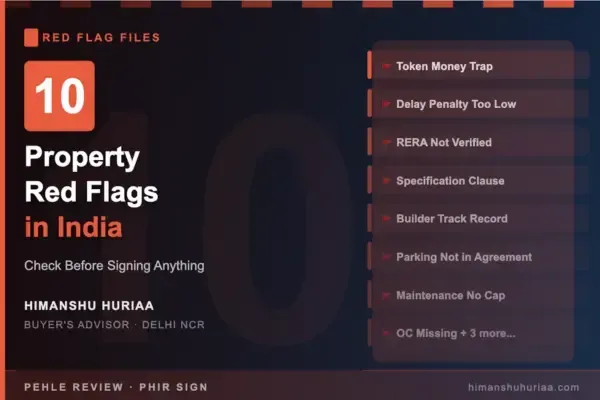
10 Property Red Flags in India: What Every Buyer Must Check Before Signing Anything | Himanshu Huriaa
Most property mistakes in India are not caused by the market.
They are caused by decisions made without enough information — before signing an agreement, before verifying a builder, before understanding what is actually being purchased.
Over 5 years of reviewing 50+ property deals across Gurgaon, Noida, and Delhi NCR, I have seen the same red flags appear repeatedly. Some cost buyers lakhs. Some cost them years.
This is the complete list — what to look for, what it means, and what to do about it.
Red Flag 1
Token Money Without a Written Refund Clause
This is the most common and most costly mistake first-time buyers make.
Token money — the initial booking amount — is not automatically refundable. If an agreement is not signed or a deal falls through, the builder can legally retain it if there is no written refund clause.
What to do: Before paying any token, ask for it in writing — 'Token is refundable if the Agreement to Sale is not executed within [X] days.' Without this line, your money is at risk.
This applies even in RERA-registered projects. RERA does not automatically make token money refundable — the agreement terms do.
Red Flag 2
Possession Delay Penalty Below ₹10 Per Sq Ft Per Month
Most builder agreements include a possession delay penalty — but the rate is often so low it is meaningless.
A typical clause reads: '₹5 per square foot per month.' On a 900 sq ft flat, that is ₹4,500 per month. If your EMI is ₹50,000 per month, the penalty covers less than 10% of your actual financial loss.
What to do: Before signing, negotiate the delay penalty to a minimum of ₹15 per sq ft per month. Ask for it to be linked to the SBI base lending rate for even stronger protection. Builders do agree — if you ask before signing.
Red Flag 3
RERA Registration Expired or Not Verified
A builder giving you a RERA number is not the same as having a valid RERA registration. Registrations expire and can be revoked.
If a project's RERA registration is not active, you lose the primary legal protection available to buyers in India — including the right to file a complaint under RERA.
What to do: Visit your state's RERA website directly. Search the project name or number. Check the status — it must say 'Registered.' If it says 'Expired,' 'Revoked,' or 'Lapsed,' do not proceed. This takes two minutes and costs nothing.
Red Flag 4
Specification Change Clause in the Agreement
Many builder agreements contain a line that reads: 'The developer reserves the right to alter specifications without prior notice.'
This single clause legally allows the builder to change the flooring, fittings, materials, and even layout of your flat — without informing you. The Italian marble in the model flat can legally become standard tiles in your actual flat.
What to do: Identify this clause before signing. Ask the builder to replace it with: 'Specifications as per the approved RERA plan — no material change without the buyer's written consent.' If they refuse, that refusal itself is information.
Red Flag 5
Builder's Previous Project Still Delayed
A builder launching a new project while existing buyers from previous projects are still waiting for possession is a significant pattern to understand.
New project launches generate fresh capital. In some cases, that capital helps manage existing delayed projects — meaning new buyers are effectively funding old commitments.
What to do: On your state's RERA portal, search the builder's name — not just the new project. Look at all their registered projects. If any show 'Delayed' status or have active buyer complaints, that track record is directly relevant to your decision.
Red Flag 6
Car Parking Not Specified in the Agreement
Salespersons routinely say 'parking is included.' Agreements sometimes do not say the same.
If the specific parking spot — type, number, and location — is not written into the agreement, it may not legally be yours. This has led to disputes in multiple housing societies after possession.
What to do: Before signing, check the agreement for the word 'parking.' The spot number, type (covered, open, or stilt), and location should all be documented. A verbal assurance carries no legal weight.
Red Flag 7
Maintenance Charges With No Cap
Until a housing society is formally handed over to residents, the builder controls maintenance charges. Without a cap, these can increase significantly year on year.
A ₹3,000 per month maintenance charge can become ₹8,000 within a few years — a difference of ₹6 lakh over ten years that was not visible at the time of purchase.
What to do: Ask for the maintenance rate to be fixed for a defined period in the agreement. If that is not possible, ask for an annual escalation cap of 5%. This is a negotiable term — and it is only negotiable before you sign.
Red Flag 8
No Occupancy Certificate in a Resale Property
The Occupancy Certificate (OC) is issued by the municipal authority after verifying that a building has been constructed as per the approved plan and is safe to inhabit.
Without an OC, living in the flat is technically illegal. Banks will not provide a home loan against a property without an OC. And resale becomes difficult because the next buyer faces the same problem.
What to do: For any resale property, request the original OC or a certified copy. Do not accept 'it will come' as an answer — either it exists or it does not.
Red Flag 9
Pricing on Super Area Instead of Carpet Area
Super area includes the walls, corridors, lift lobby, staircase, and common areas — all shared spaces. Carpet area is the actual floor space inside your flat.
The difference between super area and carpet area is typically 25 to 40%. A flat quoted at 1,200 sq ft on super area may deliver only 780 sq ft of usable carpet area.
RERA requires builders to quote prices on carpet area. If a builder is still quoting on super area, ask for the carpet area rate explicitly. To compare projects fairly: total price divided by carpet area gives you the actual per-square-foot cost.
Red Flag 10
Cancellation Clause With High Forfeiture
If you need to cancel a booking — for any reason — the cancellation clause determines what you lose. Many builder agreements specify 15 to 25% forfeiture of the total booking amount.
On an ₹80 lakh flat, a 20% forfeiture means ₹16 lakh lost if you cancel. This creates a trap: even if you discover serious problems after signing, exiting becomes very expensive.
What to do: Before signing, negotiate the cancellation clause to a maximum of 10% forfeiture within the first 90 days. This is standard and most builders accept it when asked before signing — not after.
What to Do With This List
Print it. Save it. Share it with anyone who is evaluating a property.
These are not rare edge cases — they appear regularly in standard builder agreements across NCR. The difference between buyers who face problems and those who do not is almost always in the preparation done before signing.
A good deal survives scrutiny. A bad deal cannot.
If you are currently evaluating a property in Delhi NCR and want an honest review of the builder, the agreement, and the deal —
WhatsApp 'Property REVIEW' to +91-8448-701333.
Further Reading
Protect yourself before signing anything:
Understand the bigger picture:
Property Buying Guide: The Complete Step-by-Step Roadmap Before You Invest
Return Is Not The First Question: A Framework For Property Growth
Disclaimer: This content is for educational purposes only and does not constitute financial, legal, or investment advice. Please conduct independent due diligence and consult relevant professionals before making any property decision.