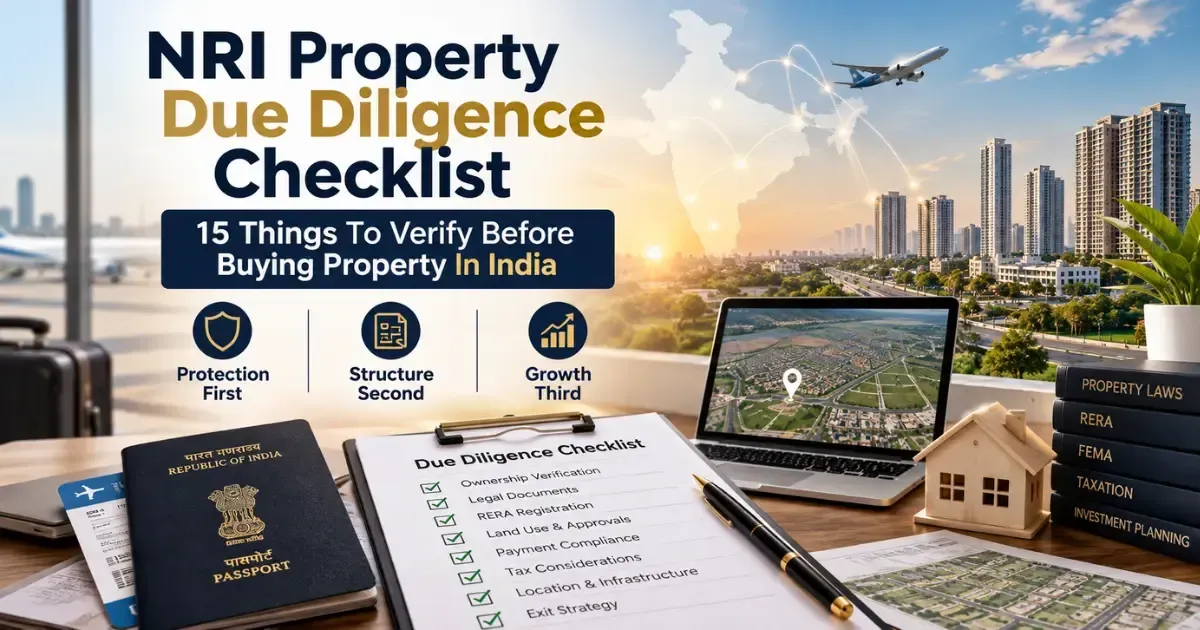
NRI Property Due Diligence Checklist | India Guide
Buying property in India while living abroad can be both exciting and challenging.
For many NRIs, property ownership is connected to family, future relocation, retirement, rental income, or creating a long-term legacy.
The challenge is that most decisions are made remotely.
Information often comes from relatives, developers, brokers, social media, property portals, or WhatsApp groups. While these sources may be useful, none of them should replace independent verification.
Before evaluating returns, future appreciation, or infrastructure announcements, buyers should first verify whether a property is legally sound, properly documented, and aligned with their purpose.
This guide provides a practical due diligence checklist to help NRI buyers make more informed property decisions.
Why Due Diligence Matters For NRI Buyers
Property problems rarely happen because a brochure looked attractive.
They usually happen because:
Ownership was not verified properly.
Approvals were not checked.
Documentation was incomplete.
Agreements were signed without review.
Decisions were made based on assumptions rather than evidence.
A structured due diligence process helps reduce avoidable risks before capital is committed.
15 Things To Verify Before Buying Property In India
1. Confirm Whether You Are Eligible To Buy The Property
Under FEMA regulations, NRIs and OCIs can generally purchase residential and commercial property in India. Agricultural land, farmhouses, and plantation properties are treated differently and require additional review. Payments must be made through permitted banking channels.
Before proceeding, confirm:
Property type
Ownership structure
FEMA applicability
State-specific restrictions
2. Verify The Seller's Ownership
The first question is not:
"Is this a good investment?"
The first question is:
"Does the seller have legal ownership?"
Review:
Registered Sale Deed
Mother Deed (where applicable)
Chain of Title Documents
Mutation Records
Ownership should be traceable through every transfer.
3. Check For Encumbrances
An encumbrance may affect ownership rights or future transferability.
Request:
Encumbrance Certificate
Loan closure documents
Mortgage release documents
Charge registration details
The goal is to identify any financial or legal obligations attached to the property.
4. Verify RERA Registration
For applicable projects, verify registration directly through the relevant state RERA portal.
Review:
Registration status
Approved plans
Project disclosures
Construction updates
Do not rely solely on marketing presentations or advertisements.
5. Define The Purpose Of Your Purchase
Many buyers evaluate properties before clarifying why they are buying.
Ask yourself:
Is this for future relocation?
Is this for retirement?
Is this for parents?
Is this for rental income?
Is this for long-term wealth preservation?
Is this for legacy planning?
Different objectives require different property strategies.
6. Review The Developer's Track Record
Before making a commitment, review:
Completed projects
Delivery timelines
Customer feedback
Litigation history
Regulatory compliance
Past execution often provides valuable insight into future performance.
7. Verify Land Records
This becomes particularly important when evaluating:
Plots
Land parcels
Growth corridors
Emerging markets
Review:
Survey Number
Ownership records
Land classification
Applicable planning approvals
For buyers exploring planned development regions, understanding land planning frameworks is important.
Related Reading:
8. Confirm Land Use And Zoning
Not every parcel can be used for every purpose.
Verify whether the property is designated for:
Residential use
Commercial use
Industrial use
Agricultural use
Future plans should align with permitted land use regulations.
9. Review The Agreement Carefully
Many buyers spend weeks evaluating a property and only minutes reviewing the agreement.
Pay attention to:
Possession timelines
Cancellation provisions
Refund clauses
Delay compensation
Maintenance obligations
Additional charges
Consider independent legal review before signing.
10. Understand Payment Compliance
FEMA requires property payments to be made through permitted banking channels such as inward remittances or eligible NRE, NRO, and FCNR accounts. Payments should not be made through traveller's cheques or foreign currency notes.
Maintain:
Bank transfer records
Payment receipts
Remittance documentation
Tax records
A proper audit trail can help avoid future complications.
11. Understand Tax Implications
Tax obligations may vary depending on:
Residency status
Property type
Rental income
Holding period
Future sale transactions
Recent tax rulings have highlighted the importance of correctly identifying tax residency and complying with applicable TDS requirements in property transactions.
Professional tax advice can help clarify obligations before proceeding.
12. Evaluate Location Fundamentals
Growth should be supported by fundamentals, not assumptions.
Review:
Connectivity
Infrastructure development
Employment generation
Population trends
Economic activity
Ask:
Why will people live here?
Why will businesses operate here?
What creates long-term demand?
13. Create An Exit Strategy Before You Buy
Many buyers focus on acquisition and ignore eventual exit.
Consider:
Resale demand
Market liquidity
Potential buyer profile
Holding period
Understanding the exit path often improves the quality of the purchase decision.
14. Plan For Property Management
Owning property remotely introduces practical responsibilities.
Consider:
Tenant management
Maintenance coordination
Utility management
Documentation storage
Local representation
A management plan can reduce future friction.
15. Conduct Independent Verification
This may be the most important step in the entire process.
Do not rely on a single source.
Cross-check:
Developer claims
Broker statements
Documentation
Ownership records
Regulatory approvals
Independent verification often provides the clearest picture.
The Buyer Decision Framework™
Before making any property decision, ask three questions.
Protection First
Is the property legally sound?
Structure Second
Does it align with my purpose, timeline, and financial situation?
Growth Third
Does the location have sustainable long-term demand drivers?
When these questions are answered in the right order, property decisions tend to become clearer and more objective.
NRI Property Due Diligence Checklist (Quick Summary)
Before committing capital, verify:
✅ Eligibility under applicable regulations
✅ Ownership records
✅ Title history
✅ Encumbrance status
✅ RERA registration
✅ Developer track record
✅ Land records
✅ Land use permissions
✅ Agreement terms
✅ Payment compliance
✅ Tax implications
✅ Location fundamentals
✅ Exit strategy
✅ Property management plan
✅ Independent verification
Common Mistakes NRI Buyers Make
Buying Before Defining The Objective
A property purchased for retirement may not be ideal for rental income.
Trusting Marketing Without Verification
Marketing creates awareness.
Verification creates confidence.
Focusing Only On Appreciation
Future growth matters.
Protection comes first.
Ignoring Exit Planning
Every purchase decision eventually becomes a sale decision.
Relying On One Source Of Information
Independent verification remains essential.
Final Thoughts
Property decisions deserve more than property information.
For many NRIs, a property purchase represents:
A future home
A retirement plan
A connection to family
A long-term legacy
The purpose of due diligence is not to eliminate every risk.
The purpose is to reduce avoidable risks before they become expensive problems.
Before evaluating future appreciation, ask:
Is the property protected?
Is the decision structured?
Does the growth case make sense?
Protection First.
Structure Second.
Growth Third.
Frequently Asked Questions
Can NRIs Buy Property In India?
Yes. NRIs and OCIs can generally purchase residential and commercial property in India subject to applicable FEMA regulations. Agricultural land, farmhouses, and plantation properties have separate restrictions.
Can An NRI Buy Property Without Visiting India?
Yes. Many transactions are completed remotely using authorised representatives and legally executed documentation. Independent verification remains important.
What Is The Most Important Document To Verify?
There is no single document. Ownership records, title history, encumbrance status, approvals, and agreements should be reviewed together.
Can NRIs Buy Plots In India?
NRIs can generally purchase residential and commercial plots, subject to applicable regulations and local planning requirements.
What Is An Encumbrance Certificate?
An Encumbrance Certificate helps identify registered financial or legal liabilities attached to a property during a specified period.
Should NRIs Verify RERA Registration?
Yes. For applicable projects, RERA verification should form part of the due diligence process.
How Should NRIs Pay For Property Purchases?
Payments should be made through permitted banking channels, including eligible NRE, NRO, or FCNR accounts and inward remittances.
Is Due Diligence Necessary When Buying From A Reputed Developer?
Yes.
Developer reputation is only one part of the evaluation process. Documentation, approvals, ownership, agreements, and suitability should still be verified.
Further Reading
Disclaimer
This article is intended for educational purposes only.
It should not be considered legal, financial, tax, or investment advice.
Property buyers should independently verify title records, planning documents, approvals, land use regulations, and all relevant information before making any property decision.