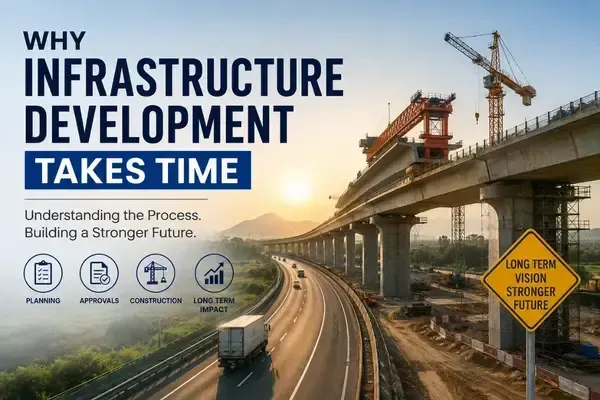
Why Infrastructure Development Takes Time: What Every Property Buyer Should Know | Himanshu Huriaa
Every Buyer Wants to Know, "When Will Development Happen?"
Whenever a new expressway, industrial corridor or major infrastructure project is announced, I notice that one question comes up almost immediately:
"How long will it take?"
It's a fair question. Buyers naturally want to understand when they might start seeing visible changes in an area.
The reality is that infrastructure development is a journey, not an event.
Understanding that journey helps buyers make more thoughtful property decisions and avoid unrealistic expectations.
Infrastructure Is More Than Building Roads
When people hear about infrastructure, they often think only of highways or expressways.
In reality, large infrastructure projects involve much more.
They typically include:
Planning and feasibility studies
Government approvals
Land acquisition
Engineering and design
Road and utility construction
Industrial and logistics development
Supporting commercial and residential growth
Each phase depends on the previous one, which is why major projects often take several years to mature.
Development Happens in Layers
One observation I have made while interacting with buyers is that many expect visible transformation immediately after a project is announced.
That rarely reflects how development actually unfolds.
Usually, connectivity improves first.
Businesses begin evaluating opportunities.
Industrial activity follows where appropriate.
Employment and supporting services gradually expand.
Only over time does a region begin to reflect the impact of these changes.
Patience is often one of the most valuable qualities a long-term property buyer can have.
Why This Matters for Naugaon
Naugaon is drawing attention because of its improving connectivity and the broader infrastructure developments taking place around the region.
That does not mean everything changes overnight.
It means buyers should understand the broader context, verify information carefully and think beyond short-term expectations.
When evaluating any location, including Naugaon, it is helpful to ask:
What infrastructure is planned?
What has already been completed?
How does the location connect to surrounding economic activity?
Does the property itself meet legal and practical requirements?
These questions often matter more than trying to predict immediate outcomes.
Infrastructure Can Influence Growth, Not Guarantee It
Infrastructure can improve accessibility, encourage business activity and support long-term regional development.
However, no infrastructure project guarantees appreciation.
Property decisions should never be based solely on announcements.
Factors such as legal verification, ownership clarity, location, accessibility, future planning and individual financial circumstances all deserve equal attention.
Thoughtful decisions come from understanding the complete picture.
My Perspective as a Buyer's Advisor
Over the years, I have found that buyers who make calmer, better-informed decisions are usually those who understand the difference between news and development.
Announcements create headlines.
Development takes time.
As a Buyer's Advisor, I believe every property decision should begin with Protection First, follow a structured approach and then allow growth to become the outcome—not the assumption.
That philosophy has shaped how I evaluate opportunities and how I guide buyers through important property decisions.
Final Thoughts
Infrastructure has the potential to shape regions over many years.
Understanding how that process works helps buyers develop realistic expectations and make decisions with greater confidence.
Rather than asking, "How quickly will this area grow?", a more useful question is:
"Am I making a well-informed decision based on facts, verification and long-term thinking?"
For me, that is where thoughtful property ownership begins.
Frequently Asked Questions
Is Naugaon part of the Delhi–Mumbai Industrial Corridor?
Naugaon benefits from infrastructure developments occurring around the Delhi–Mumbai Industrial Corridor region, which aims to improve connectivity and economic activity across several states.
Why does infrastructure development take time?
Large infrastructure projects involve planning, approvals, land acquisition, engineering, utility development and phased construction. These processes typically take several years to complete.
What is the objective of the Delhi–Mumbai Industrial Corridor (DMIC)?
The Delhi–Mumbai Industrial Corridor aims to improve industrial growth, logistics and connectivity by developing world-class infrastructure across the corridor.
Why are infrastructure corridors important?
Infrastructure corridors improve transportation, support employment, strengthen logistics and contribute to long-term regional economic development.
Does infrastructure guarantee land appreciation?
No. Infrastructure may influence demand and economic activity over time, but appreciation is never guaranteed. Every property decision should be based on legal verification, location, market conditions and individual financial objectives.
Further Reading
Understand the long-term impact:
See how this applies in Dholera:
Government Sources
Disclaimer: This content is for educational purposes only and does not constitute financial, legal, or investment advice. Please conduct independent due diligence and consult relevant professionals before making any property decision.