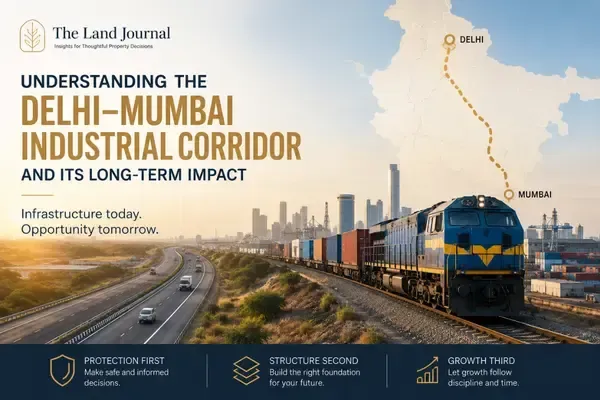
Delhi–Mumbai Industrial Corridor (DMIC): What Every Land Buyer Should Know Before Investing
Infrastructure projects often attract attention because of the opportunities they may create. Yet thoughtful property decisions require patience, perspective and an understanding that infrastructure development is a long-term process rather than a short-term event.
The Delhi–Mumbai Industrial Corridor (DMIC) is one of India's most ambitious infrastructure initiatives. Built around the Western Dedicated Freight Corridor, the project aims to strengthen manufacturing, logistics and connectivity between Delhi and Mumbai.
Stretching approximately 1,500 kilometres, the corridor passes through six states and seeks to create modern industrial and economic ecosystems.
What Is the Delhi–Mumbai Industrial Corridor?
The Delhi–Mumbai Industrial Corridor is part of India's National Industrial Corridor Development Programme. Its objective is to create globally competitive industrial regions supported by modern infrastructure and improved logistics.
The project derives strength from the Western Dedicated Freight Corridor, which is designed to improve freight movement and reduce logistics costs.
Why Does Infrastructure Matter?
Infrastructure influences economic activity.
Improved roads, freight corridors, logistics hubs and industrial clusters can contribute to:
• Better connectivity.
• Increased business activity.
• Employment generation.
• Demand for warehousing and logistics.
• Urban expansion over long periods.
However, infrastructure alone does not guarantee appreciation, nor does every location benefit equally.
Rajasthan and the Corridor
Rajasthan is among the states expected to benefit from the Delhi–Mumbai Industrial Corridor.
Over the years, several industrial and investment nodes have been identified across the state. In addition, the Delhi–Mumbai Expressway and other infrastructure developments are improving connectivity and attracting interest from industries and logistics players.
These developments have increased attention towards various parts of Rajasthan, including areas that lie within the broader influence of these infrastructure networks.
Infrastructure Development Requires Patience
Infrastructure projects are measured in decades rather than months.
Many investors make the mistake of assuming that announcements automatically translate into immediate growth.
In reality, development often follows a gradual path:
Infrastructure → Economic Activity → Demand → Growth
Patience and proper expectations are essential.
Risks and Considerations
Thoughtful property decisions begin with protection.
Before considering any opportunity, buyers should:
• Verify ownership and title documents.
• Understand zoning and land use regulations.
• Avoid excessive concentration in a single asset.
• Maintain financial liquidity.
• Take a long-term view rather than chasing short-term excitement.
Infrastructure can create opportunities, but discipline remains equally important.
Protection First • Structure Second • Growth Third
At The Land Journal, I believe growth should follow protection and structure.
Property decisions should help families create a secure and independent future through choices that are safe, structured and in their control.
Infrastructure developments such as the Delhi–Mumbai Industrial Corridor deserve attention, but they should always be viewed through the lens of patience, due diligence and long-term thinking.
Final Thoughts
The Delhi–Mumbai Industrial Corridor represents one of India's most significant long-term infrastructure initiatives.
Its impact will continue to unfold over the coming years and decades.
For thoughtful buyers and long-term thinkers, the objective should not be to predict outcomes with certainty, but to remain informed, disciplined and patient.
Because sustainable growth is rarely built on excitement. It is built on clarity, structure and time.
Frequently Asked Questions
Which states are covered by the Delhi–Mumbai Industrial Corridor?
The corridor passes through Delhi, Haryana, Uttar Pradesh, Rajasthan, Gujarat and Maharashtra.
Does infrastructure guarantee land appreciation?
No. Infrastructure creates possibilities, but appreciation is influenced by multiple factors and is never guaranteed.
Why is patience important?
Infrastructure-led development usually unfolds over many years and should be viewed with a long-term perspective.
What should buyers verify before purchasing land?
Ownership documents, title clarity, zoning regulations and overall financial allocation should always be reviewed.
References
Government Sources
National Industrial Corridor Development Corporation (NICDC)
Department for Promotion of Industry and Internal Trade (DPIIT)
Publications
Further Reading
Understand infrastructure first:
See a live example:
Disclaimer: This content is for educational purposes only and does not constitute financial, legal, or investment advice. Please conduct independent due diligence and consult relevant professionals before making any property decision.