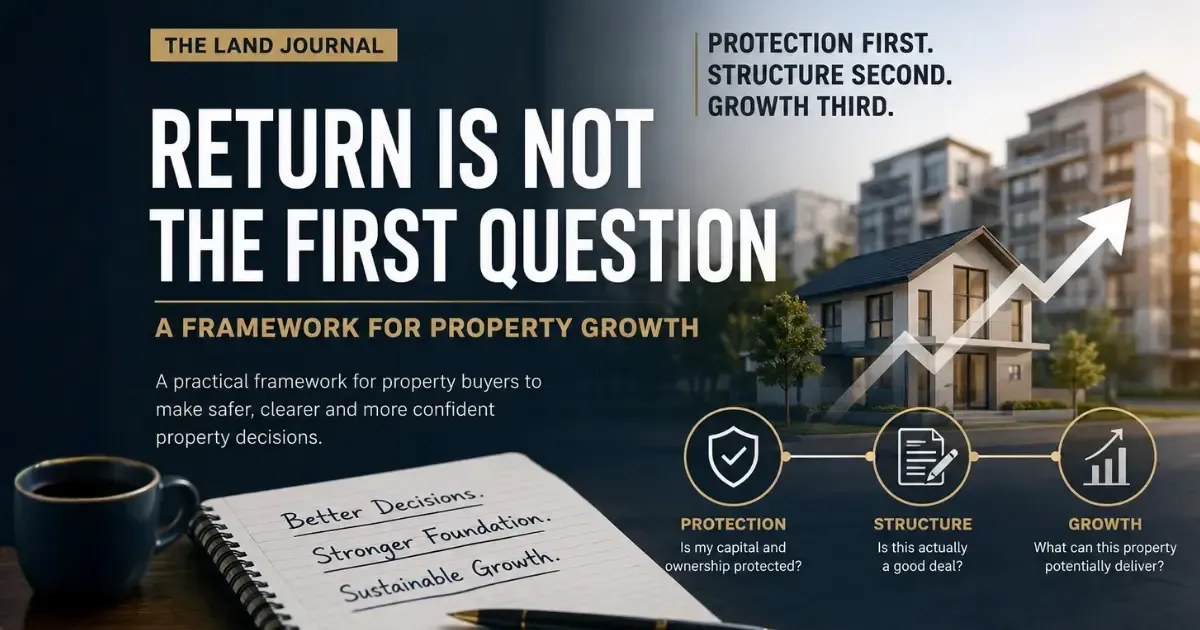
Return Is Not the First Question: A Framework for Property Growth | Himanshu Huriaa
When people start looking for a property, one question usually comes up very quickly:
“Sir, return kitna milega?”
It is a fair question.
After all, nobody wants to invest in a property without understanding its potential.
But there is a problem with making return the first question.
A property can have an attractive projected return and still be a poor investment if the buyer has not properly understood what they are buying, what risks they are taking, and how the deal is structured.
That is why I believe property decisions should follow a different philosophy:
Protection First. Structure Second. Growth Third.
Growth matters.
But growth should come after protection and structure—not before them.
Why Buyers Start With Return
The property market naturally encourages buyers to think about returns.
You will hear questions like:
“Kitna appreciation ho sakta hai?”
“5 saal mein kitna return milega?”
“Rental yield kya hai?”
“Aaj ₹1 crore hai, future mein kitna hoga?”
“Is location mein price kitna badhega?”
These questions are important.
The problem is not asking them.
The problem is asking them too early.
Imagine two properties.
Property A is being projected to deliver 40% growth.
Property B is being projected to deliver 20% growth.
At first glance, Property A looks like the obvious choice.
But then you discover that Property A has unresolved documentation issues, unclear contractual obligations, or important approvals that need further verification.
Suddenly, the comparison changes.
The question is no longer:
“Which property can give me more return?”
It becomes:
“Which property gives me a stronger foundation from which to pursue that return?”
That is a completely different way of looking at property.
The Three Questions Every Property Buyer Should Ask
Before thinking about growth, I believe a buyer should work through three levels of decision-making.
1. Protection First
The first question is:
“Is my money, ownership and position as a buyer properly protected?”
This is where verification comes in.
Depending on the property and transaction, this can involve understanding:
Who actually owns the property?
Are the title documents clear?
Are the relevant documents available and consistent?
What approvals or permissions are applicable?
Are there any known encumbrances or liabilities?
What exactly does the agreement say?
What happens if something promised by the seller does not happen?
What are the buyer's rights and obligations?
This stage is not exciting.
There is no glamorous presentation attached to it.
Nobody gets excited about checking documents.
But this is where a large part of the buyer's risk is identified.
And that is why it comes first.
Protection is not about eliminating every possible risk.
It is about understanding the risks before committing your money.
2. Structure Second
Once the basic protection is understood, the next question is:
“Is this actually a well-structured deal?”
This is different from simply asking whether the property is good.
A property can be good.
But the deal can still be poorly structured.
For example, a buyer should understand:
What exactly am I purchasing?
What is included in the transaction?
What am I paying for?
What are my future obligations?
What is clear today?
What is dependent on something happening later?
What assumptions are being made about the future?
Where are the potential gaps?
What is my exit strategy?
Where do I have negotiation leverage?
This is where many buyers stop looking at the property and start understanding the transaction.
That distinction is important.
Because negotiation is not always about asking:
“Can you give me a discount?”
Sometimes the strongest negotiation comes from identifying something in the deal that needs to be addressed.
For example, if a buyer discovers a genuine gap or risk that has not been properly reflected in the pricing or terms, that information can change the negotiation.
The buyer is no longer negotiating simply because they want a cheaper price.
They are negotiating based on facts.
That is what structure can create:
Clarity.
And clarity creates control.
3. Growth Third
Only after Protection and Structure have been properly considered should the buyer ask:
“What can this property potentially deliver?”
Now we can have the growth conversation.
This can include:
Capital appreciation
Could the property benefit from increasing demand, limited supply or improving infrastructure?
Rental income
Is there genuine rental demand from the people who are likely to occupy the property?
Location growth
What is changing around the property?
Are employment centres, connectivity, infrastructure or economic activity improving?
Demand and liquidity
Who is likely to buy this property from you in the future?
Because a property is not valuable simply because someone predicts that its price will increase.
There needs to be a reason why future buyers may be willing to pay more.
Long-term wealth creation
How does the property fit into the buyer's broader financial and family objectives?
This is where property becomes more than a transaction.
It becomes part of a long-term plan.
The Biggest Mistake: Reversing the Sequence
The problem begins when buyers reverse the order.
They start with:
Growth → Return → Investment
And only later think about:
Structure → Protection
By then, the buyer may already be emotionally committed.
They have visited the property.
They have spoken to the salesperson.
They have imagined their future there.
They have told their family.
They may even have started negotiating.
Once emotions enter the picture, asking difficult questions becomes harder.
This is why I believe the sequence matters.
Protection First. Structure Second. Growth Third.
It helps the buyer make the decision with a clearer head.
A High Return Does Not Automatically Mean a Good Investment
There is another important distinction.
A promised return and an actual investment outcome are not the same thing.
A salesperson can tell you that a property can appreciate significantly.
A brochure can show projected future prices.
A presentation can highlight infrastructure coming to the area.
A market can genuinely have strong growth potential.
But none of these automatically guarantees your return.
The future is uncertain.
That does not mean growth projections are useless.
It means they should be treated as projections, not promises.
A sophisticated buyer does not ask only:
“How much can I make?”
They also ask:
“What has to happen for me to make that money?”
That second question is far more powerful.
What Has to Happen for the Return to Materialise?
Suppose someone tells you:
“This property can potentially double in five years.”
Instead of immediately getting excited, ask:
Why?
What will drive that growth?
Is it:
New infrastructure?
Increasing demand?
Limited supply?
Employment growth?
Improved connectivity?
Development in the surrounding area?
Population growth?
Rental demand?
A change in land use?
A planned commercial or industrial ecosystem?
And then ask another question:
How certain is each assumption?
This doesn't mean you should reject every property with uncertainty.
Every investment has uncertainty.
It means you should understand where the growth thesis comes from.
That is the difference between buying because someone told you there will be growth and buying because you understand the factors that could potentially create that growth.
The Buyer Should Own the Decision
One of the biggest principles behind my work as a Buyer's Advisor is simple:
The buyer should remain in control of the decision.
Not the salesperson.
Not the developer.
Not the broker.
Not the person promising the highest return.
And not even the excitement of the opportunity.
The buyer should have enough clarity to say:
“I understand what I am buying, I understand the risks, I understand the structure, and I understand why I believe the property has growth potential.”
That is a much stronger position than:
“Someone told me this property will give good returns.”
A Simple Property Decision Framework
Before committing to a property, ask yourself these three sets of questions.
Protection First
What could put my money or ownership at risk?
Structure Second
Is the transaction properly structured, and do I understand what I am agreeing to?
Growth Third
Once the first two are satisfactory, what is the genuine growth opportunity?
Notice what this framework does.
It does not tell you to ignore returns.
It tells you to earn the right to focus on returns by first understanding protection and structure.
The Goal Is Not the Highest Return
This may sound counterintuitive in a market where everyone talks about appreciation.
But I don't believe the goal of property buying should simply be:
“Find the property with the highest expected return.”
The goal should be:
“Make a property decision where the risk is understood, the transaction is structured properly, and the growth opportunity makes sense.”
That is a very different objective.
Because a high projected return with poor protection can create a very uncomfortable investment.
A moderate projected return with strong fundamentals, clear structure and understood risks may ultimately be the better decision.
The answer is not always the property with the highest number.
The answer is the property that makes sense for you, after you have understood the complete picture.
Property Growth Should Be the Result, Not the Starting Point
This is the philosophy I follow:
Protection First.
Because your capital deserves to be protected before you start chasing growth.
Structure Second.
Because you need clarity about the deal before you can evaluate whether it is actually a good one.
Growth Third.
Because once protection and structure are in place, you can evaluate the property's potential with a much clearer perspective.
This doesn't eliminate risk.
It doesn't guarantee returns.
And it doesn't predict the future.
What it does is give the buyer a better decision-making process.
And in property, the quality of the decision can matter just as much as the property itself.
Final Thought
The next time someone shows you a property and you find yourself asking:
“Sir, return kitna milega?”
Pause for a moment.
Ask three questions first:
Is my money and ownership protected?
Is this deal properly structured?
And only then — what is the growth potential?
Because property growth is important.
But growth should be the third question, not the first.
Protection First. Structure Second. Growth Third.
That is how I believe buyers can make property decisions that are safer, more structured, and more in their control.
Frequently Asked Questions
Is return the most important factor when buying property?
No. Return is important, but it should not be the first consideration. A buyer should first understand whether the property and transaction are adequately protected and properly structured. Only then should potential growth be evaluated.
What does “Protection First” mean in property buying?
Protection First means understanding the risks associated with the property and transaction before committing capital. This can include ownership, documentation, applicable approvals, contractual terms, liabilities and other factors relevant to the specific property.
What does “Structure Second” mean?
Structure Second means understanding how the transaction is actually built: what you are buying, what you are paying for, your obligations, important terms, potential gaps, negotiation points and your possible exit route.
Does a high projected return mean a property is a good investment?
Not necessarily. A projected return depends on assumptions about future demand, infrastructure, pricing, liquidity and other factors. A high projection should encourage more due diligence, not less.
How should I evaluate the growth potential of a property?
Look at the factors that could potentially create future demand and value—such as infrastructure, connectivity, employment, economic activity, supply and demand, rental demand and liquidity. Then assess how realistic those assumptions are.
Should I ignore return when buying property?
No. Return remains an important part of the decision. The point is to evaluate it after understanding protection and structure, rather than allowing a projected return to drive the entire decision.
What is the right sequence for making a property decision?
The philosophy is:
Protection First. Structure Second. Growth Third.
The objective is not to eliminate all risk or guarantee returns. It is to make the decision with greater clarity and control.
Related Articles
Property Buying Guide: The Complete Step-by-Step Roadmap Before You Invest
How to Verify Land Before You Buy | Delhi NCR Buyer's Guide
Builder-Buyer Agreement: 5 Clauses Every Property Buyer Should Understand
How Industrial Corridors Influence Land Values
Why Infrastructure Development Takes Time
Sources
Department of Land Resources, Government of India
State RERA authority / official RERA sources