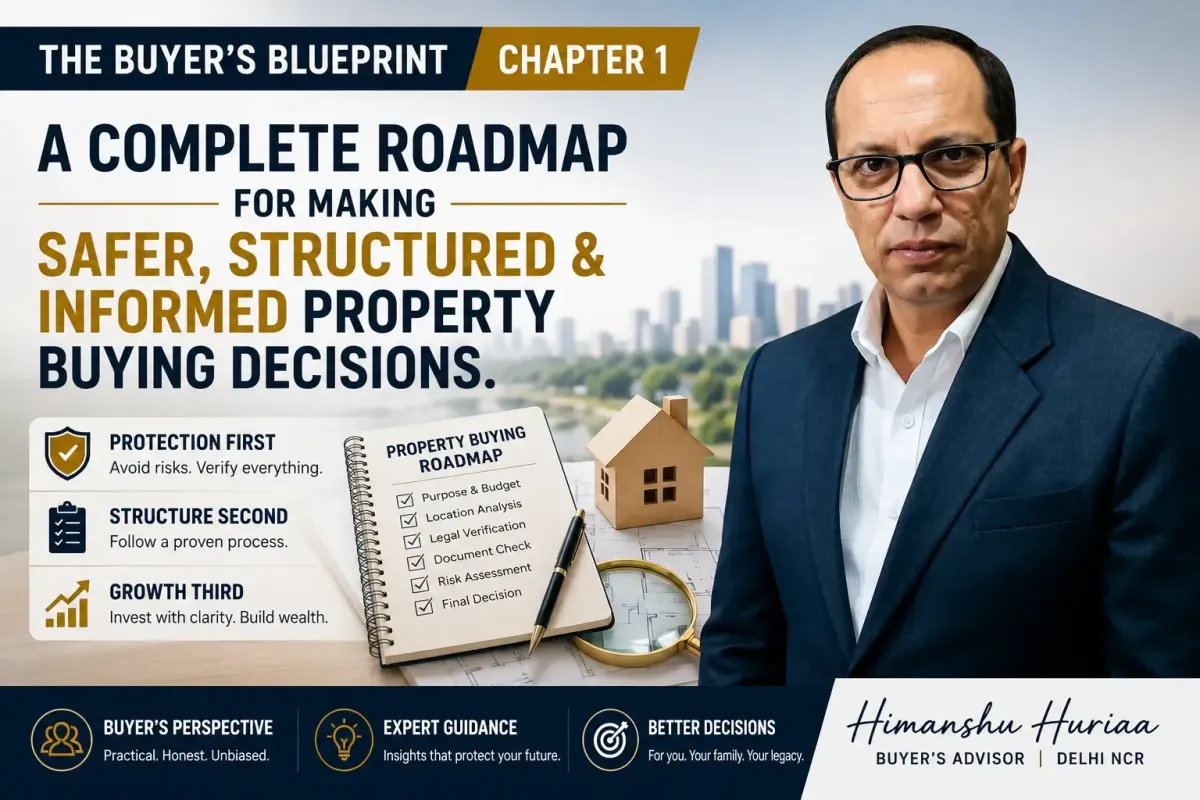
Property Buying Guide: The Complete Step-by-Step Roadmap Before You Invest
The Buyer's Blueprint
Chapter 1
A complete roadmap for making safer, structured and informed property buying decisions.
"Buying property isn't about finding the right project. It's about making the right decision."
Every year, thousands of families invest their life savings in real estate.
Some create long-term wealth.
Some buy a home they cherish for decades.
Unfortunately, many others experience delays, legal disputes, unexpected costs, poor investment returns, or properties that simply don't align with their financial goals.
The difference rarely lies in luck.
It usually lies in the process they followed before buying.
Most buyers start with the wrong question.
Instead of asking:
"What should I buy?"
they should first ask:
"How should I decide?"
That single shift in thinking can transform the entire buying journey.
Because property buying is not just another purchase.
It is one of the most significant financial decisions most people will ever make.
Unlike buying a phone or a car, property decisions involve large amounts of capital, long-term commitments, legal documentation, financing, taxation, maintenance, and future family aspirations.
A mistake today may affect your finances for years.
A well-informed decision, on the other hand, can provide security, stability, and long-term wealth.
That's why this guide exists.
Welcome to The Buyer's Blueprint
This guide is the first chapter of The Buyer's Blueprint—a flagship educational series published through The Land Journal.
The objective isn't to convince you to buy a particular project.
Nor is it to predict which location will deliver the highest returns.
Instead, this series helps you build something far more valuable:
A repeatable decision-making framework.
Markets will change.
Prices will rise and fall.
New launches will come and go.
Government policies will evolve.
But a sound decision-making process remains valuable throughout your property journey.
Whether you are buying your first apartment, investing in land, upgrading your home, or building a real estate portfolio, the principles discussed in this series remain relevant.
My Philosophy
After observing hundreds of buyer journeys and studying how successful property decisions are made, one pattern becomes clear.
People who build wealth through real estate rarely depend on luck.
They follow a disciplined process.
That philosophy can be summarised in three simple principles:
Protection First.
Protect your capital before chasing returns.
Structure Second.
Create a clear decision-making framework before selecting a property.
Growth Third.
Focus on appreciation and wealth creation only after reducing unnecessary risks.
This philosophy forms the foundation of everything you'll read throughout The Buyer's Blueprint.
You'll notice that every chapter, every checklist, and every framework follows these three principles.
Why Most Buyers Make Mistakes
Property buying mistakes usually don't happen because buyers lack intelligence.
They happen because buyers are forced to make decisions in environments designed to create urgency.
You've probably heard statements like:
"Prices are increasing next month."
"Only a few units are left."
"This offer ends today."
"Everyone is investing here."
"You may miss the opportunity."
None of these statements answer the only question that truly matters:
Is this the right property for you?
Sales urgency often replaces buyer clarity.
Instead of analysing facts, many buyers react emotionally.
That is where expensive mistakes begin.
The Difference Between Buying and Investing
Many people use the words buying and investing interchangeably.
They are not the same.
Buying simply means acquiring an asset.
Investing means allocating capital with a clear objective and a defined strategy.
Imagine two buyers purchasing apartments in the same building.
The first buyer purchases because the project looks attractive.
The second buyer purchases after evaluating affordability, legal compliance, infrastructure plans, rental demand, exit opportunities, and long-term objectives.
Both bought property.
Only one followed an investment process.
Real estate should never be treated as an impulse purchase.
It should be treated as a strategic financial decision.
The Property Buying Journey
Many buyers believe property buying begins with a site visit.
It doesn't.
The journey actually starts much earlier.
A structured property buying process looks like this:
Define your purpose.
Assess your financial readiness.
Understand the market.
Shortlist suitable locations.
Conduct due diligence.
Evaluate the builder.
Review legal documentation.
Compare available options.
Make an informed decision.
Plan for ownership and future growth.
Skipping even one of these steps can increase unnecessary risk.
Before You Buy Any Property, Understand This
Every property buyer eventually asks one question:
Which property should I buy?
While important, it is not the first question.
The better question is:
What kind of buyer am I?
Your answer influences every decision that follows.
For example:
A first-time homebuyer has different priorities than an experienced investor.
Someone buying for self-use evaluates properties differently from someone focused on rental income.
Land investments require a different framework than ready-to-move apartments.
Long-term wealth creation requires different thinking than short-term speculation.
Until you understand your own objective, every project appears attractive.
Once your objective becomes clear, many options naturally eliminate themselves.
That is why every successful property journey begins with self-clarity rather than project selection.
Step 1: Define Your Purpose
Before visiting a single project, answer one simple question:
Why are you buying this property?
Your purpose becomes the foundation of every future decision.
Broadly, buyers fall into one or more of the following categories:
Self-Use
You're looking for a home that supports your family's lifestyle, commute, education, healthcare access, and long-term comfort.
Investment
Your focus is on capital appreciation, rental income, or portfolio diversification.
Retirement
Your priorities include peaceful surroundings, healthcare facilities, accessibility, and long-term affordability.
Legacy
You're creating an asset that can benefit future generations and become part of your family's long-term wealth.
None of these objectives is better than another.
But each requires a different evaluation framework.
Buying without a defined purpose is like starting a journey without deciding the destination.
You may still reach somewhere—but not necessarily where you intended to go.
Step 2: Assess Your Financial Readiness
Buying property is not just about arranging the booking amount or qualifying for a loan.
It is about understanding the complete financial commitment.
A responsible buyer should evaluate:
Monthly household income
Existing EMIs and liabilities
Emergency savings
Down payment availability
Loan eligibility
Registration and stamp duty costs
Interior and furnishing expenses
Maintenance charges
Future cash flow requirements
One common mistake is stretching finances to purchase a larger property while compromising overall financial stability.
A home should strengthen your financial future—not become a source of constant stress.
Step 3: Choose the Right Location Before the Right Property
One of the most common mistakes buyers make is falling in love with a building before understanding the location.
Experienced buyers reverse this process.
They study the location first.
Then they evaluate the property.
A property's long-term value depends on factors far beyond its architecture.
Look for indicators such as:
Connectivity
Employment hubs
Educational institutions
Healthcare infrastructure
Upcoming expressways
Metro expansion
Commercial development
Government master plans
Population growth
Future demand drivers
Buildings age.
Locations evolve.
Over the long term, location often influences property performance more than finishes, amenities, or launch offers.
Step 4: Conduct Property Due Diligence (in the next chapter)
Frequently Asked Questions
What is the first step in buying a property?
The first step is defining your purpose. Understand whether you're buying for self-use, investment, retirement, or legacy before evaluating any property.
How much down payment should I have before buying a property?
While requirements vary, having a sufficient down payment along with emergency savings and funds for registration, interiors, and other costs helps you make a financially comfortable purchase.
What documents should I verify before buying a property?
Verify ownership documents, title records, approvals, RERA registration (where applicable), sanctioned plans, and other relevant legal documents. Conduct proper due diligence before making any commitment.
Is RERA applicable to every property?
No. RERA generally applies to projects that meet the criteria specified under the Real Estate (Regulation and Development) Act, 2016. Always check your respective State RERA Authority for project registration details.
What factors should I consider while choosing a location?
Evaluate connectivity, employment hubs, infrastructure, educational institutions, healthcare, future development plans, and long-term demand rather than focusing only on the property itself.
Should I buy property for self-use or investment?
There is no universal answer. The right decision depends on your financial goals, lifestyle needs, risk tolerance, and long-term objectives.
Why is due diligence important before buying property?
Due diligence helps verify legal ownership, approvals, builder credibility, and potential risks. It can reduce the chances of financial, legal, or operational issues after purchase.
What is The Buyer's Blueprint?
The Buyer's Blueprint is an educational series by Himanshu Huriaa that helps buyers make safer, structured, and informed property decisions through the philosophy of Protection First. Structure Second. Growth Third.
Continue Your Buyer's Journey
If this guide helped you think differently about property buying, here are your next steps:
✅ Take the Buyer's Assessment – Understand your property readiness.
✅ Read Chapter 2: Property Due Diligence – Learn how to protect your investment before you buy.
Coming Soon
→ Chapter 3 – Property Fraud Prevention
→ Chapter 4 – Complete RERA Guide
✅ Apply for High Tea with Himanshu Huriaa – Join an invite-only educational session for thoughtful property buyers.
Suggested References
Government & Regulatory Sources
The Real Estate (Regulation and Development) Act, 2016 (RERA)
Official legislation governing India's real estate sector.
Ministry of Housing and Urban Affairs (MoHUA), Government of India
Housing policies, urban development initiatives and regulatory information.
Project registrations, builder disclosures and buyer complaint mechanisms.
Department of Land Resources, Government of India
Land administration and land governance information.
Home loan regulations, financial literacy and lending practices.
Housing finance and residential market reports.
Tax implications relating to property ownership and transactions.
Industry Research
Further Reading
Protection First
Structure Second
Growth Third
Buying property is one of the few financial decisions that can influence your lifestyle, financial security and future opportunities for decades.
The market will continue to change.
New projects will launch.
Prices will rise and fall.
Infrastructure will evolve.
But one principle remains constant:
Well-informed decisions create better long-term outcomes than emotionally driven purchases.
The purpose of this guide was never to tell you what to buy.
Its purpose was to help you understand how to decide.
If this article leaves you with one thought, let it be this:
Don't choose a property first. Choose your decision-making framework first.
Because the right framework protects more than your money.
It protects your future.
And that is the philosophy behind every article published in The Buyer's Blueprint:
Protection First. Structure Second. Growth Third.
Disclaimer: This content is for educational purposes only and does not constitute financial, legal, or investment advice. Please conduct independent due diligence and consult relevant professionals before making any property decision.