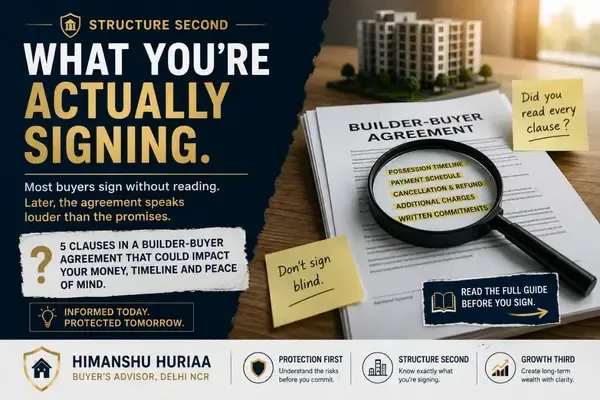
Builder-Buyer Agreement: 5 Clauses Every Property Buyer Should Understand
Most buyers spend weeks researching locations, comparing projects, visiting sites and negotiating prices.
Yet, when the Builder-Buyer Agreement is placed in front of them, many sign within minutes.
Ironically, one of the most important documents in the buying journey often receives the least attention.
This guide explains the five clauses every buyer should understand before signing.
In This Guide
Why Most Buyers Skip Reading the Agreement
Five Clauses Every Buyer Should Understand
A Better Way to Approach Property Buying
Final Thoughts
Frequently Asked Questions
Why Most Buyers Skip Reading the Agreement
It isn't because buyers are careless.
Most people simply assume that:
The builder is reputed.
The agreement must be standard.
Everything has already been explained verbally.
Legal documents are too complicated.
Unfortunately, assumptions can become expensive later.
The goal isn't to become a lawyer.
The goal is to become an informed buyer.
Five Clauses Every Buyer Should Understand
1. Possession Clause
One of the first things buyers usually ask is:
"When will I get possession?"
But the better question is:
What exactly does the agreement say about possession?
Understand:
Expected possession date
Grace period
Reasons for delay
Buyer's rights if timelines are exceeded
Knowing these details helps you plan your finances and expectations realistically.
2. Payment Schedule
Every payment demand should follow the agreed payment structure.
Understand:
Construction-linked plans
Time-linked plans
Due dates
Interest on delayed payments
Conditions under which payments become payable
Never assume every demand letter must automatically be paid without checking whether it aligns with the agreement.
3. Cancellation and Refund Terms
Life changes.
Job transfers happen.
Financial priorities change.
Ask yourself:
If you decide not to continue, what does the agreement say?
Understand:
Cancellation charges
Refund timelines
Conditions affecting refunds
Any deductions that may apply
It's always better to know your options before you need them.
4. Additional Charges
Many buyers focus only on the property's quoted price.
However, there may also be costs such as:
Maintenance charges
Club membership
Parking
Infrastructure or utility deposits
Registration and government charges
Applicable taxes
Understanding the complete financial commitment helps avoid unpleasant surprises.
5. Verbal Promises vs Written Commitments
This is perhaps the simplest advice I share with every buyer:
If it isn't written, don't assume it's guaranteed.
Whether it's possession timelines, amenities, payment flexibility, or special commitments, ask for written confirmation whenever possible.
Documentation creates clarity.
A Better Way to Approach Property Buying
Buying property should never be driven only by excitement.
It should be guided by understanding.
The objective isn't to become suspicious of every builder.
The objective is to become confident in your own decision.
That is why I follow a simple framework:
Protection First.
Understand the risks before committing.
Structure Second.
Know exactly what you're signing and why.
Growth Third.
Only after protection and structure should appreciation and returns become the focus.
Final Thoughts
Buying a property isn't just about choosing the right project. It's also about understanding the commitments you're making before you sign.
Every Builder-Buyer Agreement is different, and every buyer's situation is unique. The purpose of this guide isn't to make you suspicious of every agreement—it is to help you become a more informed buyer.
Better questions lead to better decisions.
Better decisions create greater confidence.
Protection First • Structure Second • Growth Third
Frequently Asked Questions (FAQs)
What is a Builder-Buyer Agreement?
A Builder-Buyer Agreement is a legal contract between the property developer and the buyer. It outlines important details such as the property's specifications, payment schedule, possession timeline, cancellation terms, and the rights and obligations of both parties. It forms the foundation of the purchase transaction.
Is a Builder-Buyer Agreement legally binding?
Yes. Once signed by both parties, a Builder-Buyer Agreement becomes a legally binding document. Buyers should understand the key terms before signing, and seek professional or legal advice if they have concerns about any clause.
Why should I read the Builder-Buyer Agreement before signing?
The agreement defines your financial commitments, possession timeline, payment obligations, cancellation conditions, and other important terms. Reading it carefully helps you understand what you are agreeing to and reduces the chances of misunderstandings later.
Which clauses are most important in a Builder-Buyer Agreement?
Some of the key clauses buyers should review include:
Possession timeline
Payment schedule
Cancellation and refund policy
Additional charges
Default and penalty clauses
Force majeure provisions
Maintenance responsibilities
Dispute resolution process
The importance of each clause depends on your individual situation.
Can a Builder-Buyer Agreement be negotiated?
Some terms may be negotiable depending on the developer, the project, and the stage of the purchase. While many agreements follow a standard format, buyers can still seek clarification, request changes where appropriate, or ask for written confirmations regarding specific commitments.
What documents should I check before signing a Builder-Buyer Agreement?
Besides reviewing the agreement itself, buyers may consider verifying documents such as:
RERA registration details
Approved building plans
Land ownership documents
Project approvals
Payment schedule
Cost sheet
Allotment letter (if issued)
The exact documents required may vary from project to project.
What happens if the builder delays possession?
The consequences of delayed possession depend on the terms stated in the Builder-Buyer Agreement and applicable laws. Buyers should review the possession and delay-related clauses carefully to understand the remedies, compensation provisions (if any), and available options.
Should I consult a lawyer before signing a Builder-Buyer Agreement?
If you are unsure about the legal implications of any clause, consulting a qualified property lawyer can provide clarity. This is particularly useful for high-value transactions or when the agreement contains complex terms.
What is the biggest mistake buyers make before signing?
One of the most common mistakes is relying solely on verbal assurances without verifying whether those commitments are reflected in the written agreement. Buyers should ensure that any important promises are documented.
How can a Buyer's Advisor help before signing?
A Buyer's Advisor helps you evaluate the property decision from the buyer's perspective by reviewing the overall transaction, asking the right questions, identifying potential risks, and helping you make an informed decision. A Buyer's Advisor does not replace a lawyer but can complement the decision-making process by focusing on clarity, structure, and due diligence.
Suggested References & Further Reading
Official Resources
Further Reading
Before signing any agreement:
Verify before you commit:
One Final Thought
Markets will continue to change.
New projects will launch.
Prices will rise and fall.
Regulations will evolve.
But one principle rarely changes:
The quality of your property decision depends less on what you buy and more on how you decide.
The purpose of this guide wasn't to tell you which property to choose.
It was to help you understand what questions to ask before you choose.
Because informed buyers don't rely on luck.
They rely on clarity.
And clarity comes from following a simple framework:
Protection First.
Structure Second.
Growth Third.
That philosophy is at the heart of every article published in The Land Journal.
Continue Your Buyer's Journey
If this guide helped you make more informed property decisions, here are a few next steps to continue learning.
📖 New to Property Buying?
Start with the complete roadmap before exploring individual topics.
→ Property Buying Guide: The Complete Step-by-Step Roadmap Before You Invest
📋 Explore Your Buyer Decision Profile
Understand your current buying stage, priorities, and decision-making approach before your next property purchase.
→ Start Your Buyer Decision Profile
☕ Join High Tea with Himanshu Huriaa
If you prefer learning through conversation, you can apply to join High Tea with Himanshu Huriaa—an invite-only educational discussion for thoughtful property buyers.
Disclaimer: This content is for educational purposes only and does not constitute financial, legal, or investment advice. Please conduct independent due diligence and consult relevant professionals before making any property decision.